Showing posts with label 7th CPC Pay Structure. Show all posts

Tuesday, May 17, 2016

Empowered Committee for Running Allowance in the 7th CPC Pay Structure-reg.

NFIR
National Federation of Indian Railwaymen
3, CHELMSFORD ROAD, NEW DELHI – 110 055
Affiliated to :
Indian National Trade Union Congress (INTUC)
International Transport Workers’ Federation (ITF)

No. IV/RSAC/Conf./Part VI

Dated: 11/05/2016

The Secretary (E), Railway Board,
New Delhi
Dear Sir,

Sub: Empowered Committee for Running Allowance in the 7th CPC Pay Structure-reg.

Ref: Railway Board’s order No. ERB-I/2016/23/1 dated 05/05/2016.

The Railway Board has since issued an order dated 05/05/2016 constituting Empowered Committee for Running Allowance in the 7th CPC Pay Structure. According to Board’s letter, ED/PC-I, Railway Board shall be the Convenor of the Empowered Committee and five EDs of different directorates shall function as its members.

In this connection, NFIR desires to convey that pursuant to bipartite agreement reached on the report of the Running Allowances Committee, 1980, the running allowance eligibility criteria, pay elements for various purposes, ALK etc., were decided by the Railway Ministry in the year 1981.

With the implementation of 6th CPC pay structure (Pay Band & Grade Pay), a number of aberrations have however cropped up and all those issues .were raised by NFIR in different fora. The issues were also discussed in the Fast Track Committee meetings, besides PNM and DC/JCM meetings, but unfortunately, there has been no finality till now. In the full Board meeting chaired by CRB on 7th February 2014 and in the Fast Track Committee meetings, it was decided that the running staff issues need to be dealt in the joint committee and accordingly joint committee was constituted.. Although the joint committee met twice, the issues remained unresolved.

Now that the Railway Board has constituted Empowered Committee in the wake of 7th CPC repOrt presently under consideration of the Government, the NFIR urges upon the Railway Board that the issues which are pending before the Joint Committee should be got finalized quickly. Thereafter there should be formal meetings with the Federations for discussing the new issues which may arise consequent upon the decision for implementation of VIIth CPC Pay Matrix levels. In this context, the Federation wants to remind the Railway Board that the pay elements 30% and 55% of pay which are in vogue since the time of 4th CPC should be continued without any dilution even when 7th CPC Pay Matrix levels are to be implemented.

Federation hopes that the Railway Board would take note of earlier agreements reached with the Federations for ensuring that the same are not deviated.

Yours faithfully

Sd/-
(Dr. M. Raghavaiah)
General Secretary
Copy to the Executive Director/PC-I, Railway Board, New Delhi.

Source: http://www.nfirindia.org/
Read More »

Sunday, November 22, 2015

7th CPC Basic Pay Calculation Method in brief with illustration

Know Easy steps to Calculate your 7th Pay Commission New Pay Scale

7th Pay commission simplified the calculation for arriving revised Pay through new 7th CPC Pay Metrix

We here illustrate the method through easy 6 Steps to calculate our 7th CPC New Pay and Allowances to know your self

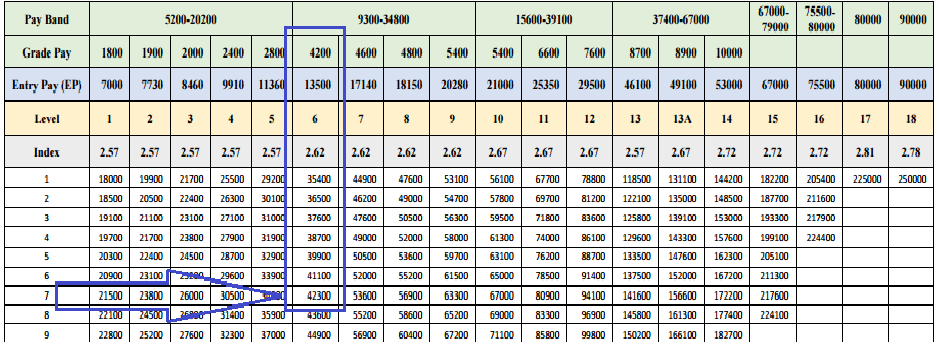
Lat us Assume you are drawing Grade Pay Rs.4200 and Pay in the Band Pay Rs.12110

To calculate your Basic Pay and Allowance follow the steps given below.

Step-I

Calculate your sixth CPC basic Pay 
( Grade Pay + Band Pay) = 4200+12110= 16310

Step-II

Multiply the above figure with 7th CPC Fitment Formula 2.57
16310 x 2.57 = 41916.70 . ( Paisa to be rounded off to the nearest Rupee)
The Ans is = Rs.41917

Step-III

Match this Answer with Matrix Table ( Given Below) Figures assigned in Grade Pay column Rs.4200

There is no matching figure we arrived above in this matrix, so the closest higher figure assigned in the Grade Pay column can be chosen ie is Rs. 42300

So , Rs 42300 is your New 7th CPC Basic Pay

Step-IV

Identify your HRA [ See : 7th Pay commission recommendation on HRA]

HRA has been revised as 24%, 16% and 8% for 30% , 20% and 10% respectively

So if you are in 30% HRA Bracket, your HRA in 7th CPC is 24% vis versa.

Let us assume now you are in 30% HRA bracket, your revised HRA is 24%

Find the 24% of the Basic Pay = 42300 x 24/100 = 10152

Your HRA is Rs.10152

Step-V

Identify your TPTA (Transport Allowance)

7th CPC Recommends Transport Allowance for three Category of Employees for Two Types of Places

If you are living in A1 and A classified cities (See the List of 19 cities classified as A1 and A cities) you will be entitled to get higher TPTA rates

7th cpc TPTA Transport Allowance

And since your Grade Pay is 4200 you fall in Second category

ie Grade Pay 2000 to 4800 – Rs 3600+DA

Your TPTA is Rs. 3600/- (DA is Nil as on 1.1.2016)

Step-VI

(Sine DA will be Zero from 1.1.2016 So no need to calculate the DA to calculate 7th Pay and Allowances from 1.1.2016)

Add all the figures

New Basic Pay + HRA+TPTA = 42300+10152+3600 = 56052

Your revised 7th CPC Grass pay as on 1.1.2016 = Rs.56052


Read More »

Thursday, November 19, 2015

7th CPC Report submitted – 23.55% increase in salary when taking increase in allowances also – Net Pay increase is 16%

7th pay commission report Highlights:

Minimum pay is 18,000/-

Grade Pay System abolished

fitment formula will be 2.57. So using present basic pay, 7th CPC pay can be calculated by multiplying the same with 2.57 factor.

Increase in Military service Pay increased to 16,500

3% annual increment

52 allowances abolished

16% increase in pay

23.55% increase overall salary when taking in to increase in allowances also
24% increase in Pension

In a bonanza for central government employees, the Seventh Pay Commission on Thursday submitted its final report to Finance Minister Arun Jaitley recommending a 22-23 percent jump in their salary and allowances.

The Pay Commission headed by Justice A K Mathur has suggested a 15 percent increase over the basic salary plus DA for the central government staff. An increase in allowances like HRA has also been recommended.

The total increase will be 23.55 percent of the gross salary (basic plus DA plus allowances). The pay commission has also  proposed a status quo on the retirement age of central government employees. Retirement age for central government employees is 60 years now.

The recommendations of the 7th Pay Commission are scheduled to take effect from January 1, 2016.

Besides Chairman, other members of the commission are Vivek Rae, a retired IAS officer of 1978 batch, and Rathin Roy, an economist. Meena Agarwal is secretary of the commission.

The central government constitutes the pay commission every 10 years to revise the pay scale of its employees and often these are adopted by states after some modifications.

The Commission was set up by the UPA government in February 2014 to revise remuneration of about 48 lakh central government employees and 55 lakh pensioners.

The Union Cabinet had extended the term of the panel in August by four months, till December. The 6th Pay Commission was implemented with effect from January 1, 2006.

Read More »

7th CPC to Submit Report on Today November 19th 2015, 19.30 Hrs.

“Once every ten years, the salaries and perks of Central Government employees are completely revised. The previous revision was implemented on 01.01.2006. The new set of salaries and benefits will come into effect from 01.01.2016 onwards.”

The 7th Pay Commission, under the chairmanship of Justice A.K.Mathur, will submit its 900-page report to the centre tomorrow at 19.30 Hrs.

A review of the 7th Central Pay Commission :-

25.09.2013 – P. Chidambaram, the then Minister of Finance, made headlines when he announced the proposal to constitute the 7th Pay Commission.

04.02.2014 – The then Prime Minister, Manmohan Singh gave approval for constituting the 7th Pay Commission. Under the chairmanship of Justice A.K.Mathur, a four-member Pay Commission committee was formed (1. Justice Ashok Kumar Mathur, Chairman; 2. Vivek Rae, Member; 3. Dr. Rathin Roy, Member; and 4. Mrs. Meena Agarwal, Secretary).

28.02.2014 – The Terms of Reference were issued to the Pay Commission, with the approval of the cabinet.

The Pay Commission was given 18 months time to complete its work. This time around, the commission managed to effectively complete its task, almost on time.

The Pay Commission visited various places in the country to personally inspect the work conditions and gather feedback from the workers associations and representatives.

Opinions were invited from all, and not just the NC JCM Staff Side, Confederations and major employees unions and associations.

The Pay Commission hosted its own website where it regularly updated its progress.

In a section called “Questionnaire,” the commission asked questions to the visitors and gathered online feedback from them.

24.06.2014 – the NC JCM Staff Side presented a Memorandum to the Pay Commission, containing the suggestions and proposed pay structure of nearly 45 lakh employees and also such demands for 50 lakh pensioners.

25.06.2015 – The Pay Commission made an important announcement on its website. It said that task on the report will end very soon and it will be submitted to the government on time.

The report, which was supposed to be submitted in August, was delayed when the Pay Commission, on 27.08.2015, asked for an extension of four months to complete its report.

The OROP protests and Bihar polls are believed to be the reasons for submitting the report much ahead of December. Initially, the Pay Commission was expected to submit its report on November 20 or 23. But, PTI announced yesterday that the report will be submitted on November 19.

And Today the official website of 7th CPC also published the date and time of submission of its report to the Central Government.

Experts and various sources expect 15 to 20 percent hike in the salaries. But, none has explained the basis on which the numbers were arrived at.

The employees are not just curious about the salary hikes. They are interested in other aspects, including Promotions, Retirement Age, DA merger, Increment, Grade Pay, HRA, Bonus, LTC, and the removal of certain pay anomalies of the 6th Pay Commission are some of the expectations.

Courtesy:http://90paisa.blogspot.in/
Read More »

Tuesday, November 17, 2015

7th CPC likely to submit its final report on 20th November 2015 - TOI

NEW DELHI: The 7th Central Pay Commission is likely to submit its final report to finance ministry on November 20 which is due for implementation from January 1, 2016.

More than 48 lakh serving central government employees and 54 lakh pensioners will be impacted by the 7th CPC which is likely to recommend an average hike of 15%, said a source.

The 900-page report is believed to have made suggestions on parity of 36 organized Group A services with the IAS which has so far largely dominated in superior positions in the central government.

The pay panel was constituted in February 2014 and was asked to submit its report within 18 months. However, in August the government gave the panel four months extension to submit its report by December.

Its recommendation will guide how the salary and various allowances of central staff will be revised besides improving their service condition. The report would also impact all the public sector employees and central autonomous bodies which generally make corrections as per the hikes given to the central staff.

Even before the report was finalized there was intense lobbying seen where all the 36 organised Group A services petitioned the commission seeking parity with the IAS and determination of central postings based on merit.

The IAS officers too had sent their individual dissention notes to department of personnel and training and the cabinet secretariat besides the pay panel demanding that their edge and superiority be maintained.

One of the demands of the Group A services is to change the composition of the Civil Services Board which is responsible for central staffing. As of now this is dominated by IAS officers and has no representation from any other service. The pay panel may recommend changes that would ensure level playing field for all officers of Group A services.

Source: TOI
Read More »

Tuesday, November 03, 2015

Removal of Grade Pay System in 7th CPC – Detailed Report

Will the removal of Grade Pay System by the 7th Pay Commission help Central Government employees? – This is the topic of this article.

“Unconfirmed reports say that the 7th Pay Commission is very likely to recommend the abolishing of the Grade Pay System introduced by the 6th Pay Commission.”

Not only the Government, but the Central Government employees too are hoping and wishing that the 7th Pay Commission functions independently, free from interventions. The report of the previous Pay Commissions will guide for determining the revision of pay scale and pay bands, allowances, retirement benefits and other facilities/benefits of more than 50 lakh employees. The Pay Commission also considers the recommendations, suggestions and inputs gathered from employees all over the country and presented as memorandums by federations like the NC JCM and the Confederation.

There is no rule that the new Pay Commission has to follow the same methodology and determination followed by the previous Pay Commissions. Therefore, one cannot state for sure that the 7th Pay Commission will tow the guidelines issued by the 6th or the 5th Pay Commission while deciding the new pay scale and pay bands.

One has to keep in mind the fact that the 6th Pay Commission was radically different from the recommendations and guidelines issued by the 5th Pay Commission. One has to also remember that a number of industry experts, who predicted the recommendations of the 6th Pay Commission based on the trends of the previous Pay Commission, were proved completely wrong.

If one Pay Commission has the right to recommend the splitting of the Pay Scale into two, the next Pay Commission has all the powers to completely abolish the system. But, this is not the issue!

Will the Central Government employees benefit by the removal of the Grade Pay system? This is the question now.

It will definitely be beneficial. Here are the reasons why.

It is unacceptable that a promotion, which comes after waiting for many years, brings with it an increment of just Rs.100.

None has until now accepted the splitting of the promotional hierarchy, which had been followed for years, into two.

The anomalies that prevailed due to the ‘Grade Pay Hierarchy’ which was introduced under the MACP promotional system, still remain unresolved.

When the discussions and debates on MACP system continued to grow unabated during the NC JCM Anomaly Committee meeting, it was decided that a separate meeting ought to be held to analyze this issue.

Most of the individual requests from the Central Government employees this time are about the MACP promotional system. The reason is the Grade Pay structure introduced by the 6th Pay Commission.

And also can list out many reasons to abolish the Grade Pay System.

Read More »

Tuesday, January 27, 2015

Estimated pay scales likely to be recommended by Seventh Pay Commission


Estimated pay scales likely to be recommended by Seventh Pay Commission

Is it possible to get the pay hike recommended or proposed by individuals..?

Estimated pay scales likely to be recommended by Seventh Pay Commission, Please see

[CLICK IMAGE BELOW FOR LARGER VIEW]


Read More »

Monday, January 19, 2015

7th Pay Commission – Estimated Pay Scales shows substantial increase in salary for CG Employees

7th Pay Commission – Estimated Pay Scales shows substantial increase in salary for CG Employees

Hurry..! 7th Pay Commission’s report to be implemented on 01.01.2016

Estimated Pay Scales shows substantial increase in salary.

New Delhi, There is a good news for Central Government employees that 7th Central Pay Commission’s report will be implemented with effect from 01.01.2016. Central Government employees are expecting merger of dearness allowance, increase in other allowances such as house rent, children education allowances etc. with the implementation of this report.
Read More »

Wednesday, September 24, 2014

Seventh Pay Commission has sought information on the parity of pay scales manifests in posts of a similar nature

MEENA AGARWAL
SECRETARY

GOVERNMENT OF INDIA
SEVENTH CENTRAL PAY COMMISSION

7CPC/99/RR/2014/1

Dated: 8th September, 2014

Dear

The 7th Central Pay Commission has been receiving a number of memoranda, representations from associations/federations as well as individual cadres on pay and related issues. As part of its working, the Commission is also hearing various groups of employees both in Delhi and during its visits outside Delhi.

2. One of the major issues raised before the Commission centres on the subject of parity. One aspect of parity manifests in how posts of a similar nature are placed. Certain cadres/category of employees have, in their deposition before the Commission, stated that there are cases when identical or similarly placed cadres/categories of employees in different Ministries/Departments are placed differentially in terms of pay and promotional prospects.

3. With a view to examining and addressing this aspect of parity amongst apparently similarly placed cadres/posts, the Commission has devised a template to be filled in for posts being administered by your Department. The template seeks to elicit information that would be readily available in the Recruitment Rules for the concerned post(s)/cadres. In case your Department only operates posts involving common cadres like the Central Secretariat Service (CSS), Central Secretariat Stenographers Service (CSSS), Central Secretariat Clerical Service (CSCS), a NIL report may kindly be furnished to the Commission.

4. Since the Work of the Commission is time bound may I request that information as sought is furnished by 25 September 2014. Perhaps a copy of the RRs themselves could be sent as advance information.

Yours sincerely,

Sd/-
(Meena Agarwal)

Source: http://confederationhq.blogspot.in/
Read More »

Wednesday, July 30, 2014

Memorandum to the 7th Central Pay Commission on issues common to All Central Government Employees- Submission of -

CONFEDERATION OF CENTRAL GOVERNMENT EMPLOYEES & WORKERS
(Central Head Quarters)

1st Floor, North Avenue Post office Building, New Delhi – 110001
Website: confederationhq.blogspot.com
E mail: confederationhq@gmail.com

No. CONF/7th CPC/Memorandum

Dated: 28th July, 2014

To
The Member Secretary,
7th Central Pay Commission,
PO Box No. 4599, Hauz Khas Post Office
New Delhi – 110016
Madam,

Sub: – Memorandum to the 7th Central Pay Commission on issues common to All Central Government Employees- Submission of 

On behalf of the Confederation of Central Government Employees and Workers, we submit the memorandum for the consideration of the Commission.

The staff side, National council, JCM vide their letter in NC-JCM-2014/7th CPC dated 30th June 2014 have submitted a memorandum in respect of issues common to all Central Government Employees. We are in agreement with the views canvassed therein and endorse the same fully.

As indicated in detail in the introductory Chapter, we have made certain additions to elucidate the views and contentions in respect of some matters and added a paragraph on certain other issues under the Chapter Miscellaneous. We request that the 7th CPC may consider our submissions and make appropriate recommendations to the Government.

Thanking you,

Yours faithfully,

(M. KRISHNAN)
Secretary General

Source-http://confederationhq.blogspot.in/2014/07/confederation-of-central-government.html
Read More »

Saturday, July 19, 2014

A glance of 7th CPC Common Memorandum – Confederation of Central Government Employees

Highlights of the Memorandum submitted on issues common to all Central Government employees to Secretary 7th Pay Commission.
JCM NC has also submitted Interim Memorandum on interim relief and Merger of DA
1. Pay scales are calculated on the basis of pay drawn pay in pay band + GP + 100% DA by employees as on 01.01.2014.
2. 7th CPC report should be implemented w.e.f. 01-01-2014. In future five year wage revision.
3.   Scrap New Pension Scheme and cover all employees under Old Pension and Family Pension Scheme.
4.   JCM has proposed minimum wage for MTS (Skilled) Rs.26,000 p.m.
5.   Ratio of minimum and maximum wage should be 1:8.
6.   General formula for determination of pay scale based on minimum living wage demanded for MTS is pay in PB+GP x 3.7.
7.   Annual rate of increment @ 5% of the pay.
8.   Fixation of pay on promotion = minimum two increments
9 (a) The pay structure demanded is as under:- (open ended pay scales – Total 14 pay scales)
Existing Proposed (in Rs.)
PB-1, GP Rs. 1800
PB-1, GP Rs. 1900
26,000
PB-1, GP Rs. 2000
PB-1, GP Rs. 2400
33,000
PB-1, GP Rs. 2800
46,000
PB-2, GP Rs. 4200
PB-2, GP Rs. 4600
56,000
PB-2, GP Rs. 4800
74000
PB-2, GP Rs. 5400
78,000
PB-3, GP 5400
88000
PB-3, GP 6600
102000
PB-3, GP 7600
120000
PB-4, GP 8900
148000
P4-4, GP 10000
162000
HAG
193000
Apex Scale
213000
Cabinet Secretary
240000
9 (b) New Pay scales minimum in comparison with Sixth CPC Grade Pay. 
Grade Pay of 6th CPC
Minimum of the new pay scale
1
1800
26000
2
1900
31000
3
2000
33000
4
2400
41000
5
2800
46000
6
4200
56000
7
4600
66000
8
4800
74000
9
5400
78000
10
5400 in PB-3
88000
11
6600
102000
12
7600
120000
13
8700
139000
14
8900
148000
15
10000
162000
16
12000
193000
17
75000-80000
202000
18
80000 fixed
213000
19
90000 fixed
240000

9 (c) Wages and service conditions of Gramin Dak Sevaks is to be examined by 7th CPC itself. Detailed Memorandum will be submitted by Postal Federations and GDS Unions.
 10. Dearness Allowances on the basis of 12 monthly average of CPI, Payment on 1st Jan and 1stJuly every year.
11.       Overtime Allowances on the basis of total Pay + DA + Full TA.
12 Liabilities of all Government dues of persons died in harness be waived.
13. Transfer Policy – Group `C and `D Staff should not be transferred. DoPT should issue clear cut guideline as per 5th CPC recommendation. Govt. should from a Transfer Policy in each department for transferring on mutual basis on promotion. Any order issued in violation of policy framed be cancelled by head of department on representation.
14. Transport Allowance -
X Classified City
Other Places
Rs. 7500 + DA
Rs. 3750 +DA

The stipulation for TA that the Govt. employee should be on duty in his headquarters for certain number of days during the calendar month should be removed.
15.       Deputation Allowance double the rates and should be paid 10% of the pay at same station and 20% of the pay at outside station.
16. Classification of the post should be executive and non-executive instead of present Group A,B.C.
17. Special Pay which was replaced with Special/Allowance by 4th CPC be bring back to curtail pay scales.
18. Scrap downsizing, outsourcing and contracting of govt. jobs.
19.       Regularize all casual labour and count their entire service after first two year, as a regular service for pension and all other benefits. They should not be thrown out by engaging contractors workers.
20.       The present MACPs Scheme be replaced by giving five promotion after completion of 8,15,21,26 and 30 year of service with benefits of stepping up of pay with junior and also hierarchical pay scales.
21. PLB being bilateral agreement, it should be out of 7th CPC per view.
22. Housing facility:-
(a)   To achieve 70% houses in Delhi and 40% in all other towns to take lease accommodation and allot to the govt. employees.
(b)   Land and building acquired by it department may be used for constructing houses for govt. employees.
23. House Building Allowance :-
(a) Simplify the procedure of HBA
(b) Entitle to purchase second and used houses
24. Common Category – Equal Pay for similar nature of work be provided.
25. Compassionate appointment – remove ceiling of 5% and give appointment within Three months.
26. Traveling Allowance:-
      Category
A1, A Class City
Other Cities
Executive
Rs. 5000 per day + DA
Rs. 3500 per day + DA
Non-Executive
Rs. 4000 per day + DA
Rs. 2500 per day + DA
27. Composite Transfer Grant: -
Executive Class 6000 kg by Goods Train/ Rate per km by road 8 Wheeler Wagon Rs.50+DA(Rs.1 per kg and single container per km)
Non-Executive Class 3000 kg – do – -do-
28. Children Education Allowance should be allowed up to Graduate, Post Graduate, and all Professional Courses. Allow any two children for Children Education Allowance.
29.       Fixation of pay on promotion – two increments in feeder grade with minimum benefit of Rs.3000.
30. House Rent Allowance
X Class Cities 60%
Other Classified Cities 40%
Unclassified Locations 20%
31. Compensatory City Allowance.
`X’ Class Cities `Y’ Class Cities
A. Pay up to Rs.50,000 10% 5%
B. Pay above Rs.50,000 6% minimum Rs 5000 3% minimum Rs.2500
32. Patient Care Allowance to all para-medical and staff working in hospitals.
33. All allowances to be increased by three times.
34. NE Region benefits – Payment of Special Duty Allowance @ 37.5% of pay.
35. Training: – Sufficient budget for in-service training.
36. Leave Entitlement
(i)      Increase Casual Leave 08 to 12 days & 10 days to 15 days.
(ii)     Declare May Day as National Holiday
(iii)    In case of Hospital Leave, remove the ceiling of maximum 24 months leave and 120 days full payment and remaining half payment.
(iv)    Allow accumulation of 400 days Earned Leave
(v)     Allow encashment of 50% leave while in service at the credit after 20 years Qualifying Service.
(vi)    National Holiday Allowance (NHA) – Minimum one day salary and eligibility criteria to be removed for all Non Executive Staff.
(vii)   Permit encashment of Half Pay Leave.
(viii) Increase Maternity Leave to 240 days to female employees & increase 30 days Paternity Leave to male employees.
37. LTC
(a) Permission to travel by air within and outside the NE Region.
(b) To increase the periodicity once in a two year.
(c) One visit outside country in a lifetime
 38. Income Tax:
(i)   Allow 30% standard deduction to salaried employees.
(ii) Exempt all allowances.
(iii) Raise the ceiling limit as under:
(a) General – 2 Lakh to 5 Lakh
(b) Sr. Citizen – 2.5 Lakh to 7 Lakh
(c) Sr. Citizen above 80 years of age – 5 Lakh to 10 Lakh
(iv) No Income Tax on pension and family pension and Dearness Relief.
39. (a) Effective grievance handling machinery for all non-executive staff.
(b) Spot settlement
(c) Maintain schedule of three meetings in a year
(d) Department Council be revived at all levels
(e) Arbitration Award be implemented within six month, if not be discussed with Staff Side before rejection for finding out some modified form of agreement.
40. Appoint Arbitrator for shorting all pending anomalies of the 6th CPC.
41. Date of Increment – 1st January and 1st July every year. In case of employees retiring on 31st December and 30th June, they should be given one increment on last day of service, i.e. 31st December and 30th June, and their retirements benefits should be calculated by adding the same.
42. General Insurance: Active Insurance Scheme covering risk upto Rs. 7,50,000/- to Non Executive & Rs. 3,50,000/- to Skilled staff by monthly contribution of Rs. 750/- & Rs. 350/- respectively.
43. Point to point fixation of pay.
44. Extra benefits to Women employees (i) 30% reservation for women.
(ii)   Posting of husband and wife at same station.
(iii) One month special rest for chronic disease
(iv) Conversion of Child Care Leave into Family Care Leave
(v)   Flexi time
45. Gratuity:
Existing ceiling of 16 ½ months be removed and Gratuity be paid @ half month salary for every year of qualifying service.
Remove ceiling limit of Rs.10 Lakh for Gratuity.
46. Pension:
(i)      Pension @ 67% of Last Pay Drawn (LPD) instead of 50% presently.
(ii)     Pension after 10 years of qualifying service in case of resignation.
(iii)    Increase pension age-based as under:
65 Years – 70% of Las Pay Drawn (LPD)
70 Years – 75% of LPD
75 Years – 80% of LPD
80 Years – 85% of LPD
85 Years – 90% of LPD
90 Years – 100% of LPD
(iv)    Parity of pension to retirees before 1.1.2006.
(v)     Enhanced family pension should be same in case of death in harness and normal death.
(vi)    After 10 years, family pension should be 50% of LPD.
(vii)   Family pension to son upto the age of 28 years looking to the recruitment age.
(viii) Fixed Medical Allowance (FMA) @ Rs.2500/- per month.
(ix)    Extend medical facilities to parents also.
(x)     HRA to pensioners.
(xi)    Improvement in ex-gratia pension to CPF/SRPF retirees up to 1/3rd of full pension.
 NB:   The above is only gist. All points raised by us not included. For understanding the entire demands raised by us, Please read the full memorandum published in our website.
 (M. Krishnan)
Secretary General
NFPE/Confederation
Source:http://confederationhq.blogspot.in/


Read More »

FREE EMAIL UPDATES

Enter your email address:

Delivered by FeedBurner