Showing posts with label 7th Pay Commission Projected Pay Scale. Show all posts

Tuesday, February 09, 2016

7th Pay Commission: Good News PMO Orders to Speed up Process; Notification Soon

7th Pay Commission: Good News PMO Orders to Speed up Process; Notification Soon

New Delhi, Feb 6: This will definitely cheer up all the central government employees who are disappointed at the moment as government is delaying the implementation of Seventh Pay Commission. Sources say that after One Rank One Pension, notification for 7th CPC could be released in coming months.

Reportedly, Prime Minister Narendra Modi has ordered officials to speed up review process so that it could be implemented soon. Modi has asked Committee of Secretaries to provide maximum benefits to central staff.

Cabinet Secretary P K Sinha headed empowered committee which was appointed to overview whole process has been told to accept pay commission’s recommendations without diluting them. PMO wants committee to review all the recommendations as soon as possible, so that Cabinet could take final decision over the same.

One of the officials was quoted by the Express News as saying, “The committee has been told to address the genuine concerns raised by stakeholders and accommodate their demands as much as possible. Although, there is indication that the committee may suggest some changes keeping in mind representations from middle and junior level, the decision will be taken after consultations with all the stakeholders. The entire process will take a couple of months”. Meanwhile, reports also say that in coming months, notification for 7th pay commission could be issue. A Finance Ministry source was quoted by news reports as saying, “One Rank One Pension (OROP) is now going to be implemented after notification. Hence Finance Ministry will issue the notification of ‘Pay Commission award’ in forthcoming months”. OneIndia News

Source : OneIndia News
Read More »

Sunday, September 06, 2015

Fiscal impact of 7th Pay Commission under watch: DBS

Bulk of the impact of Seventh Pay Commission, under which salaries of government employees will be reviewed, is likely to be absorbed by the Budget of the next financial year, 2016-17, says a DBS report.

Bulk of the impact of Seventh Pay Commission, under which salaries of government employees will be reviewed, is likely to be absorbed by the Budget of the next financial year, 2016-17, says a DBS report.

The global financial services major said pay/allowances could rise by 16 per cent following the rollout of the Seventh Pay Commission.

“If adopted, bulk of the impact (of the Seventh Pay Commission) will be absorbed by the FY16/17 Budget,” the DBS report said adding that “historically, the pay commission’s rollout has been negative for fiscal balances.”

As per DBS, the increase in bonus payments and pay/ allowances would cumulatively imply a first-round increase in spending to the tune of 0.2-0.3 per cent of GDP in FY16/17, “putting deficit targets at risk”.

“These higher spending needs will require the government to either re-channel fiscal savings, restrain spending elsewhere or renege on the fiscal deficit targets,” it added.

The Seventh Pay Commission, set up by the government to revise remuneration of about 48 lakh central government employees and 55 lakh pensioners, will submit its report by December 31.

DBS said that the full impact would get clearer when the pay commission tables its recommendations later this year.

The recommendations of the Seventh Pay Commission are scheduled to come into effect from January 1, 2016…

Read More »

Saturday, June 13, 2015

Will the 7th Pay Commission accept NC JCM’s Demand of Rs.26,000 as the Minimum Wage?

“The National Council JCM, which represents over 40 lakh Central Government employees all over India, has demanded that the minimum wages be raised to Rs.26,000 per month.”

With each passing day, new doubts and expectations keep growing in the minds of the Central Government employees, which is clearly reflected in the kind of questions that we have been receiving lately.

Members of the 7th Central Pay Commission have been touring the country for more than 10 months now.

The readers want to know when they would return to office and start drafting their report.

Will the Commission submit its report before the end of the year?

And, most importantly, will the Commission accept the NC JCM’s demand of fixing Rs.26,000 as the minimum wage?

Will 7th CPC accept NC JCM’s Demand of Rs.26,000 as the Minimum Wage?

The situation is reminiscent of a similar scene in 2006 when the NC JCM insisted the 6th Central Pay Commission that the minimum wages be raised to Rs.10,000. As per the 5th Central Pay Commission, the minimum wage at that time was Rs.2550.

At that time, many felt that the NC JCM’s request will not be granted. They said that Rs.6000 itself was an excessive amount. But the 6th Central Pay Commission fixed the amount at Rs.7000.

Now, once again similar voices of disbelief are in the air. They claim that the number is not likely to exceed Rs.16,000 this time.

The 6th Central Pay Commission did not use the methods that were used by the 5th to decide the minimum wages. It had its own process. Similarly, one cannot be sure that the 7th Central Pay Commission will follow the 6th Central Pay Commission’s method. But, it looks as if the Grade Pay Structure introduced by the 6th Pay Commission will be removed this time.

Read More »

Tuesday, June 02, 2015

7th Central Pay Commission’s Final Meeting with JCM Staff Side National Council on 9th June 2015

Jayant Sinha
Joint Secretary

Government of India
Seventh Central Pay Commission

D.O.No. 7CPC/158/Meetings/2015

27.05.2015

Dear Shiv Gopal Mishra

The Seventh Central Pay Commission has had wide ranging interaction with a variety of Stakeholders. It has had a series of meetings with National Council and the Constituents of the JCM from March 2015 onwards. The Commission has also sought views of Individual Ministries / Departments on the issues Posed in relation to matters that are relevant to the Ministries

The Commission has scheduled a final meeting of the National Council with the 7th Central Pay Commission at 11.00 am on 9th June 2015, in the Conference Room, 1st Floor, B-14/A. Chatrapati Shivaji Bhawan, Qutub Institutional Area, New Delhi

With Regards

Yours Sincerely

Sd/-
(Jayant Sinha)

Shri.Shiv Gopal Mishra
Secretary
National Council (Staff Side)
Joint Consultative Machinery for Central Government Employees
13-C, Ferozshah Road
New Delhi – 110001

Source:http://confederationhq.blogspot.in/
Read More »

Wednesday, March 04, 2015

Seventh Pay Commission likely to submit report in October 2015

After the recommendations of the Fourteenth Finance Commission (FFC) forced the government to reduce its plan expenditure in the 2015-16 budget, the Union finance ministry fears its revenues will remain constrained in 2016-17 as well since it has to absorb the recommendations of the Seventh Pay Commission (SPC) in that year. 

The SPC will submit its report by October 2015.

 “The 7th Pay Commission impact may have to be absorbed in 2016-17. The phase of consolidation, extended by one year, will also be spanning out in this period. Thus, in the medium-term framework, the fiscal position will continue to be stressed,” the finance ministry said in the macroeconomic framework statement laid before Parliament along with the budget on Saturday. 

The Union Budget reduced the plan expenditure for the first time in many years by Rs.2,657 crore to Rs.4.7 trillion in 2015-16 from the revised estimate of 2014-15, as the centre shared an additional Rs.1.86 trillion with states. The Finance Commission has raised the untied share of states in net central taxes to 42% from 32%. 

The tight fiscal situation forced the government to revise its fiscal consolidation road map and set a less ambitious fiscal deficit target of 3.9% of the gross domestic product (GDP) for 2015-16 against the earlier target of 3.6% set in last year’s budget. 

The fiscal deficit of 4.1% for 2014-15 was also achieved through a sharp reduction in plan expenditure up to Rs.1.1 trillion. Finance minister Arun Jaitley in his budget speech said he had deferred the 3% fiscal deficit target to fiscal 2017-18 from 2016-17. 

The government appointed the Seventh Pay Commission on 28 February 2014 under chairman justice Ashok Kumar Mathur with a timeline of 18 months to make its recommendations. Though the deadline for submitting the report ends in August this year, the SPC is likely to seek extension till October. 

The Sixth Pay Commission which was constituted in October 2006 had submitted its report in March 2008.

 As a result of the recommendations of the Sixth Pay Commission, pay and allowances of the Union government employees more than doubled between 2007-08 and 2011-12—from Rs.74,647 crore to Rs.166,792 crore, according to the Fourteenth Finance Commission estimates.

 “As a ratio of GDP, it jumped from a little over 0.9% in 2007-08 to 1.2% in 2008-09 and about 1.4% in 2009-10 on account of both pay revision and payment of arrears. However, it moderated to little over 1% in 2012-13,” the Finance Commission said. 

The recommendations of the Sixth Pay Commission were implemented by states with a delay mainly between 2009-10 and 2011-12, with “significant expenditure outgo” in arrears on both pay and pension counts, the FFC said. 

The FFC said that while the finance ministry projects an increase in pension payments by 8.7% in 2015-16, a 30% increase is expected in 2016-17 on account of the impact of the Seventh Pay Commission, followed by an annual growth rate of 8% in subsequent years. 

However, it maintained that given the variations across states and the lack of knowledge about the probable design and quantum of award of the Seventh Pay Commission, it is neither feasible, nor practicable, to arrive at any reasonable forecast of the impact of the pay revision on the Union government or the states. “Further, any attempt to fix a number in this regard, within the ambit of our recommendations, carries the unavoidable risk of raising undue expectations,” added the Finance Commission. 

A senior Pay Commission official, speaking under condition of anonymity, said its recommendations will surely have significant impact on the revenues of the central government. “The 14th Finance Commission was at a disadvantage since it did not have the benefit of the recommendations of the Pay Commission unlike its predecessors,” he added. 

N.R. Bhanumurthy, professor at the National Institute of Public Finance and Policy, said the FFC has tried to factor in the impact of the recommendations of the SPC on the central government expenses. “The FFC report shows the capital outlay of the central government will dip in 2016-17 to 1.4% of GDP from 1.64% a year ago due to the implementation of the Pay Commission recommendation before it starts rising to 2.9% of GDP by 2019-20,” he added. 

The FFC said that all states had asked it to provide a cushion for the pay revision likely during the award period. The FFC advocated for a consultative mechanism between the centre and states, through a forum such as the Inter-State Council, to evolve a national policy for salaries and emoluments. 

The FFC also recommended that pay commissions be designated as Pay and Productivity Commissions, with a clear mandate to recommend measures to improve productivity of employees, in conjunction with pay revisions. “We recommend the linking of pay with productivity, with a simultaneous focus on technology, skills and incentives. We urge that, in future, additional remuneration be linked to increase in productivity,” it said. 

The Pay Commission official quoted earlier said it has been mandated to recommend incentive schemes to reward excellence in productivity, performance and integrity, which it will do. “Though previous Pay Commissions have talked about linking pay with productivity, the earlier governments have not accepted such recommendations. Since this government has shown strong political will, we hope they will accept our recommendations,” he added.

Read More »

Friday, August 08, 2014

Will the Federations recommended salary hikes materialize in 7th Pay Commission..?

‘Expected Pay Scale of 7th CPC’ – This is the hottest topic of discussion among central government employees right now! Hereinafter the topic and article have become the exciting headline of discussion and make countless debates among government employees.

What will the pay scale recommended by the 7th Pay Commission be like..?

Will the 7th Pay Commission recommend the salary hike suggested by the various associations and unions..?

Particularly, Will the 7th CPC take into consideration of the proposed pay structure presented by the (JCM) Staff Side and the Confederation?

For the time being, our only answer is- we’ll have to wait and watch..!

Some of our readers have felt that the suggestions made by the NC (JCM) Staff Side and Confederation are over-ambitious and beyond the realms of imaginations. They feel that such suggestions would be even considered only by the 8th Pay Commission and also hefty hike reflected in pay scale…etc.

The associations and various federations reflect the mindset of their majority employees. Although there is no denying the fact that they have been asking for slightly high, one has to examine the way these demands were made. It is not an easy task to make a sensible memorandum based on acceptable facts. The proposed pay structure suggested by the staff side is designed on visionary thinking. In 6th pay commission also federations were suggested to fix Rs.10000 as minimum pay, but the Government had fixed it as Rs. 7000. Now they are asking to fix Rs.26000 as minimum pay instead of Rs. 7ooo.

Minimum Pay Scale in 4th CPC  Rs. 750

Minimum Pay Scale in 5th CPC  Rs. 2550

Minimum Pay Scale in 6th CPC  Rs. 7000

Minimum Pay Scale in 7th CPC  Rs.  26000 (Demanded by NC JCM Staff Side)

The crying baby only gets the milk…Nothing happens by itself.
Read More »

Wednesday, July 30, 2014

Confederation Proposed New Pay Structure and Rate of Increment in its memorandum to 7th Pay Commission

Confederation Proposed New Pay Structure and Rate of Increment in its memorandum to 7th Pay Commission

Proposed Pay Structure and Rate of Increment

In the preceding chapters we have dealt with the various principles of pay determination as was enunciated by the successive Pay Commissions. The 6th CPC introduced the new concept of Pay Band and Grade Pay. We are not able to comprehend any logical methodology having been adopted by the 6th CPC in constructing the Pay Band and Grade Pay. In the ultimate analysis, we found that there had been no uniform multiplication factor. It varied from 2.2 time to 3. The changes effected by the Government while implementing the recommendations of the 6th CPC further compounded the confusion and making it more irrational and arbitrary.

The 6th CPC in their report stated that they have upgraded certain pay scales having appreciated the contention made by the employees organizations. They merged certain other pay scales in an effort to delayering the functions. But the new pay that emerged from such upgradation/merger was not equivalent to the higher pay scales in the said group. For instance, the erstwhile pay scales of Rs.5000-8000, 5500-9000 and 6500-10500 were merged. The multiplication factor for pay band construction was 1.86 times of the minimum. Therefore the pay band for the pre merged pay scales was determined to begin at Rs.9300/-. Having merged, the pay band must have begun at 12,090/-, i.e. 1.86 times of 6500/- in which the other pay scales were merged.

7.2 The manner in which the Grade pay was devised is also questionable. At the lower level the Grade Pay progresses @ Rs.100/- ,i.e. 1800, 1900, 2000, etc. The pay in the Band + Grade Pay at the entry level is 5200 + 1800 = 7000. An employee is entitled for 3% increment every year. He gets a financial benefit of Rs. 210 every year on account an increment whereas on promotion his grade pay gets increased by just Rs.100/- only. The Grade Pay was devised at 40% of the maximum of the pre revised time scale of pay. The maximum of any time scale of pay will depend upon the rate of increment and the span of the scale of pay. The ratio between the minimum and the maximum of all pay scales was not uniform, rather it could not be uniform.

Therefore, prescribing Grade Pay as a percentage of such variable maximum, in our opinion, was erroneous. Normally fitment benefit represent the gap between pre revised minimum and the revised minimum. The 6th CPC recommendation of Grade Pay did not serve this purpose also. Having been expressed in absolute quantum amount it gave varied benefit in different pay bands as also at different stages in the same pay bands.

7.3 The Grade Pay system brought about various anomalies, which were raised at the NAC but found no resolution despite discussions on several occasions in the last 6 years. We are of the firm view that the 7th CPC should revert to the Pay Scale System which has been time tested. We have constructed the pay scales maintaining the relativities with the time scale of pay suggested by both 5th and 6th CPC.

7.4 While constructing the pay scales we have taken the rate of increments at 5% instead of 3% presently available. We have done so on the ground that most of the PSUs including the banking industries provide the incremental rate at 5% and over a period of time it raises the salary level of the personnel. We therefore request that the 7th CPC may recommend the rate of annual increment at 5%. Incidentally we may also state that the uniform date of increment prescribed by the 6th CPC has encountered certain problems and anomalies. We, therefore, suggest that the 7th CPC may recommend, for administrative expediency, two specific dates as increment dates, Viz. 1st January and 1st July. Those recruited/appointed/promoted during the period between 1st January and 30th June will have their increment date on 1st January and those recruited/appointed/promoted between 1st July and 31st December will have it on 1st July next year. This apart we request the Commission to specifically recommend that those who retire on 30th June or 31st December are granted one increment on the last day of their service.

7.5 We have also felt that a further reduction in the number of pay scales is needed. While constructing the pay scales we have removed those pay scales pertaining to Grade Pay of Rs.1900, 2400, 4600, 8700 and the scale of pay of Rs. 75500-80000. We are of the opinion that the instrument of Special Pay which was in operation earlier should be brought back to address the need of intermediary grades in certain organizations. The Associations and Federations representing the employees and officers of various departments and various categories will submit their memorandum indicating the pay scales to be assigned to the categories of the employees and officers they represent taking into account the nature of functions assigned to those categories separately.

7.6 Presently, functional promotion is made to the next hierarchical position whereas MACP promotion is Grade Pay based, irrespective of the fact whether a particular Grade Pay exist in the hierarchy or not in the concerned department. Our suggestion to reduce the number of pay scales go a great extent to obviate the difficulty encountered due to the dual system of promotion.

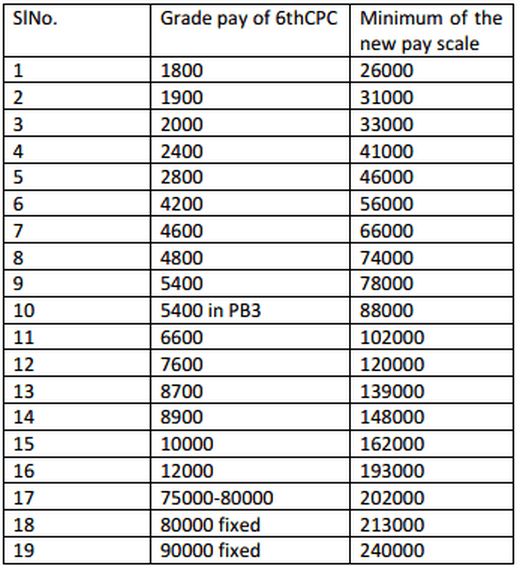
7.7 We have constructed open- ended pay scales. This is to ensure that no employee stagnates without increment. The pay of the Secretary and the Cabinet Secretary has been kept as a fixed amount as has been the recommendation of the 6th CPC. In consonance with our view on the need for further de-layering, we have suggested only 14 Pay scales indicating in the table the minimum of each of them. The said 14 pay scales are given below:

In Table 7.2, the corresponding pay scales of the 6th CPC recommended Grade Pay are given for reference.


Read More »

Tuesday, April 15, 2014

Estimated 7th Pay Commission pay scales as on 01.01.2016- view of gconnect

Estimated 7th Pay Commission pay scales as on 01.01.2016- view of gconnect

Even as the 7th Pay Commission was constituted recently by Government for revision of Pay and allowances of Central Government Employees, Railway Employees and Defence Personnels, wide spread speculations on projected 7th Pay Commission pay scales are already going on. Blogs that provide Central Government Employees news and information have already started estimating possible 7th CPC pay scales based on different ideas.

GConnect.in was the first site that launched 6th Pay Commission Pay, Pension and arrears Calculator which received atmost popularity among Central Government Employees and CG Pensioners.

In respect of revised Pay and allowances of 7th Pay Commission also GConnect would come up with similar pay and pension calculators.

As a precursor, we thought of estimating 7th Pay Commission pay bands and grade pays based on the same methods adopted by Govt for determining 6th CPC revised pay Scales from the pre-revised (5th CPC) pay scales

Before estimation of 7th CPC Pay Scales let us have a look at the 6th CPC Pay Bands and Grade Pay Structure

6th CPC revised Pay Band, Grade Pay, Starting Pay in PB and Entry Pay
Pre RevisedPay Scale
PB
6 CPCPay Band
GradePay
StartingPay
Entry PayNew Recruits
S-1, S-2
PB-1
5200-20200
1800
5200
7000
S-3
PB-1
5200-20200
1800
5360
S4
PB-1
5200-20200
1800
5530
S-5
PB-1
5200-20200
1900
5880
7730
S-6
PB-1
5200-20200
2000
6060
8460
S-7
PB-1
5200-20200
2400
7440
9910
S-8
PB-1
5200-20200
2800
8370
11360
S-9
PB-2
9300-34800
4200
9300
13500
S-10
PB-2
9300-34800
4200
10230
S-11
PB-2
9300-34800
4200
12090
S-12
PB-2
9300-34800
4200
12090
S-13
PB-2
9300-34800
4600
13860
17140
S-14
PB-2
9300-34800
4800
13950
18150
S-15
PB-2
9300-34800
5400
14880
New
PB-3
15600-39100
5400
15600
21000
S-16
PB-3
15600-39100
5400
16740
S-17
PB-3
15600-39100
5400
16740
S-18
PB-3
15600-39100
6600
19210
25350
S-19
PB-3
15600-39100
6600
18600
S-20
PB-3
15600-39100
6600
19810
S-21
PB-3
15600-39100
7600
22320
29500
S-22
PB-3
15600-39100
7600
23720
S-23
PB-3
15600-39100
7600
22320
S-24
PB-4
37400-67000
8700
37400
46100
S-25
PB-4
37400-67000
8700
39690
S-26
PB-4
37400-67000
8900
39690
49100
S-27
PB-4
37400-67000
8900
39690
S-28
PB-4
37400-67000
10000
37400
53000
S-29
PB-4
37400-67000
10000
44700
S-30
PB-4
37400-67000
12000
51850
59100
S-31
HAG
75500-80000
75500
S-32
HAG
75500-80000
75500
S-33
Apex
80000 (fixed)
S-34
Apex
90000 (fixed)
Multiplication Factor of 1.86 adopted to for revision of Pay on implementation of 6th CPC :
While implementing 6th Pay Commission Government decided to adopt a multiplication factor of 1.86 for most of the pre-revised pay Scales to determine the revised pay in band of an employee

The 6th CPC revised pay in pay band of an employee was determined by multiplying the pre-revised basic pay drawn as on 01.01.2006 with 1.86 ( Of course, some of the pre-revised pay scales at higher level was revised by multiplying a factor more than 1.86).

This multiplying factor 1.86 was arrived at by taking in to account following components of pre-revised pay received by an employee prior to 01.01.2006.
Component
Multifplication Factor
Component A – Pre-revised Basic Pay
1
Component B – Dearness Pay (50% of pre-revised Basic Pay)
0.50
Component C – 24% Dearness Allowance on pre-revised basic pay and D.P prior to 01.01.2006
0.36 (24% on factors 1+0.5 taken for B.P and D.P)
Total Multiplication Factor
1.86
Estimation of Multiplication Factor to determine 7th Pay Commission revised Pay Scales and initial pay in pay band for each pay band :

By Adopting the same method followed by the Government to decide 6th CPC multiplication factor, the following Multiplication Factor has been arrived at for determing 7th Pay Commission revised Pay Scales and initial pay in pay band for each pay band as on 01.01.2016

Component
Multiplication Factor
Component A and B – Pay in pay band and Grade Pay as on 01.01.2016
1
Component C – 124 % Dearness Allowance on Pay in pay band and Grade Pay (** See the Note Below)
1.24
Total Multiplication Factor
2.24
** Note : DA as on 1st January 2014 is 100%. So DA as on 1st January 2016 has been conservatively estimated to be 124 % (6% increase for each 6 months period)

Estimation of 7th Pay Commission Grade Pay Structure

As we all know, there was no uniform correlation between Grade Pay and Pay in Pay band in the 6th CPC Pay Band Structure. So the ratio between the present grade pay and starting pay in the pay band of particular grade pay group was taken as the factor to estimate the 7th CPC grade pay.

For example Ratio of 6th CPC Grade pay of Rs. 8700 to starting pay (Rs.37400) in that grade pay group is 0.2327. This factor is multiplied with 7th CPC starting pay (Rs.83780) to get the equivalent 7th CPC grade pay of Rs.19500. Wherever this factor exceeded 0.35, the same was fixed as 0.35.

7th Pay Commission projected Pay Scale – Revised Pay Bands, Grade Pay, Starting Pay in PB and Entry Pay
Pre Revised
Pay Scale
PB
6 CPC
Pay bands
Grade
Pay
7th CPC
Pay Band
7th CPC
Grade Pay
@ Starting
Pay
@@
Entry Pay
S-1, S-2,
1
5200-20200
1800
11650-45250
4100
11650
15680
S-3
1
5200-20200
1800
11650-45250
4100
12010
S4
1
5200-20200
1800
11650-45250
4100
12390
S-5
1
5200-20200
1900
11650-45250
4300
13180
17320
S-6
1
5200-20200
2000
11650-45250
4500
13580
18960
S-7
1
5200-20200
2400
11650-45250
5900
16670
22200
S-8
1
5200-20200
2800
11650-45250
6100
18750
25500
S-9
2
9300-34800
4200
20840-77960
7300
20840
30240
S-10
2
9300-34800
4200
20840-77960
7300
22920
S-11
2
9300-34800
4200
20840-77960
7300
27090
S-12
2
9300-34800
4200
20840-77960
7300
27090
30240
S-13
2
9300-34800
4600
20840-77960
10400
31050
38400
S-14
2
9300-34800
4800
20840-77960
10400
31250
40700
S-15
2
9300-34800
5400
20840-77960
10800
33340
New
3
15600-39100
5400
34950-87590
10800
34950
47040
S-16
3
15600-39100
5400
34950-87590
10800
37500
S-17
3
15600-39100
5400
34950-87590
10800
37500
S-18
3
15600-39100
6600
34950-87590
14800
43040
56800
S-19
3
15600-39100
6600
34950-87590
14800
41670
S-20
3
15600-39100
6600
34950-87590
14800
44380
S-21
3
15600-39100
7600
34950-87590
17100
50000
66080
S-22
3
15600-39100
7600
34950-87590
17100
53140
S-23
3
15600-39100
7600
34950-87590
17500
50000
S-24
4
37400-67000
8700
83780-150080
19500
83780
103270
S-25
4
37400-67000
8700
83780-150080
19500
88910
S-26
4
37400-67000
8900
83780-150080
20000
88910
109990
S-27
4
37400-67000
8900
83780-150080
20000
88910
S-28
4
37400-67000
10000
83780-150080
22500
83780
118720
S-29
4
37400-67000
10000
83780-150080
22500
100130
S-30
4
37400-67000
12000
83780-150080
26900
116150
132390
@ Starting Pay is the 7th CPC starting pay in a pay band against a pre-revised Scale

@ Entry Pay is the pay in pay band applicable to New Recruits.

The above table provides an idea on estimated 7th CPC Pay Band, Grade Pay and starting pay for each grade pay group. We have planned to launch an online tool to estimate 7th CPC pay in pay band and grade for a given 6th CPC pay in pay Band and grade pay. It will be released soon. Keep watching this site for this online tool.

Disclaimer: The above 7th CPC projected Pay bands, grade pay and starting pay are merely an estimation. The Actual 7th Pay Commission Pay Band, Grade Pay etc will be known only after implements the 7th Pay Commission’s recommendations. The pay structure given above may totally change based on various factors taken in to account by 7th Pay Commission to review the pay and allowances of Central Government Employees, Railway Employees and Defence personnels.

The following Government Orders relating to implementation of 6th Pay commission report have been referred to for the estimation of above mentioned 7th pay commission projected pay bands


Read More »

FREE EMAIL UPDATES

Enter your email address:

Delivered by FeedBurner